Google does not see your site the way you do. It reads links, headings, and signal patterns to build a model of what your site is about. Good site structure SEO makes that job easy; most sites accidentally make it hard.
When Googlebot visits your site, it does not admire the design or read the content the way a human does. It follows links, reads text, and notes which pages link to which. From all of that it builds a model: what topics does this site cover, which pages are most important, what is it authoritative about, and can I trust it? Strong site structure SEO gives Google a clean model to build; most sites hand it a muddled one, and their rankings suffer for it. Fixing that is core technical SEO work.
How does Googlebot discover and map your site?
Googlebot starts with pages it already knows from previous crawls or your sitemap, then follows every link it finds: navigation, body text, footer, and sitemaps. Each link leads to a page it reads and stores. The connections between pages form a map that tells Google which pages are central and which are peripheral.
Pages with many internal links pointing to them are treated as more important. Pages that sit far away in click depth, meaning you have to follow many links from the homepage to reach them, tend to be discovered and re-crawled less often.
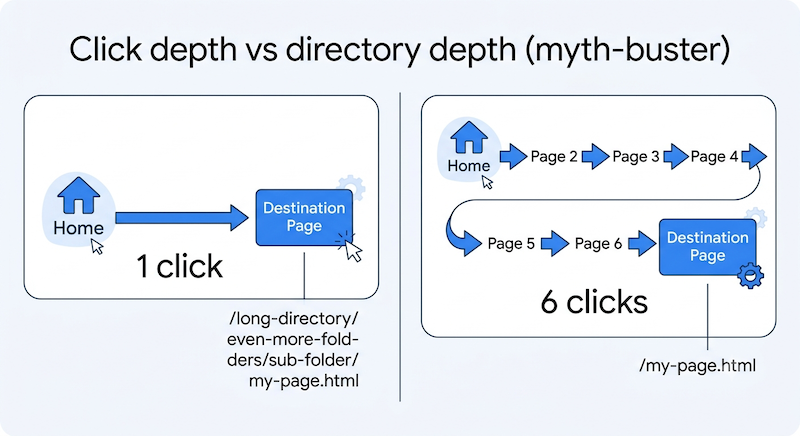
Be precise about what “deep” means here: it is the number of links in the shortest path to a page, not the number of folders in its URL. A page at /a/b/c/d/product/ is one click deep if the homepage links to it, and a page at /product/ is six clicks deep if nothing does. This crawl-frequency effect matters mostly on large sites; for a small site it is minor. Either way, it is why a deliberate internal linking structure, not a tidy folder layout, is what actually shapes how Google models your site.
What is the entity model, and what does Google think your site is about?
Modern Google does not just match keywords; it builds an entity graph from what it reads. An entity is a distinct, identifiable thing: a topic, a brand, a person, a product, a concept. Reading your site repeatedly, Google models which entities are central to your content and how they relate.
A site that consistently covers SEO, technical audits, backlink strategy, and content optimization builds a clear model: it is an SEO resource. A site covering SEO, recipes, travel tips, and car reviews builds a confused one. Google is less confident about what the second site is authoritative on, and ranks it accordingly. This is the foundation of entity-based SEO.
Does URL structure (and folder depth) matter?
Every off-topic page you add dilutes the entity model Google has built for your site. It is better to be the definitive source on one topic than a weak generalist on ten. Depth beats breadth every time, which is why we treat this as the first step toward topical authority.
Less than most people assume, and not in the way they think. A descriptive slug like flamine.com/seo/technical-seo-basics/ helps a human reading the link and gives Google a small early hint about the topic, whereas flamine.com/?p=452 gives no such hint. That is a minor clarity and click-through signal, not a ranking lever.
The number of folders in a URL is not a ranking factor for website crawlability: deep paths with four or five segments, and even opaque URLs built from long random IDs, rank perfectly well. Run almost any competitive ecommerce search and you will see product URLs several folders deep, or stuffed with parameters and UID strings, sitting near the top. The mistake to avoid is confusing the depth of a URL string with the click depth of a page; only the latter has any bearing on crawling.
What matters far more than length or folder count is that a URL is stable and canonical. Do not change URLs after publishing without a 301 redirect, because old, stable URLs accumulate links and authority over time, and every un-redirected change throws that away. A tidy, readable slug is worth having for users and click-through, but treat it as a finishing touch, not a ranking strategy.
How do headings tell Google what a page is about?
Heading tags (H1, H2, H3) are not just visual formatting; Google reads them as a structural outline. Your H1 should carry the page’s primary topic, your H2s should define the main sections, and H3s break those into subsections. A page with a clear heading hierarchy is far easier for Google to understand than a wall of text.
Use one H1 per page, and make your H2s cover the main angles of the topic, like chapters in a book. If someone reads only your headings, they should understand what the page covers. This is exactly the pattern AI retrieval systems look for when deciding which pages to cite, so good site structure SEO pays off in both channels.
URLs are signals, but they are not the hierarchy
A readable path describes the content; it does not, by itself, create structure.
/seo/technical-seo-basics/     -> category + topic, self-describing
/?p=452                        -> opaque; tells Google nothing
/seo/technical-seo-basics/?ref=nl&sort=asc  -> same page, parameter noise
Use descriptive, lowercase, hyphenated slugs under a logical category, keep them stable, and never change one without a 301. Then stop parameters from fragmenting a single page into many crawlable URLs, which wastes crawl budget and dilutes signals:
<!-- every variant points at the one canonical URL -->
<link rel="canonical" href="https://flamine.com/seo/technical-seo-basics/">
What are the most common structural mistakes?
Three errors do the most damage, and none of them is a deep-looking URL.
The first is leaving orphan pages with no internal links pointing to them, so Google barely registers they exist.
The second is mixing unrelated topics under one domain, which blurs the entity model.
The third is high click depth: important pages you can only reach after following many links from the homepage, which get discovered and re-crawled less often, mostly a concern on large sites.
Note the distinction the previous section drew, this is about link distance, not the number of folders in the URL. Fixing these, linking every important page from a relevant place, staying on-topic, and shortening the click path to key pages, resolves most site-structure problems before you touch anything more advanced. We walk through hands-on examples in three technical SEO use cases.
Your internal linking is not decoration; it is the thing that shapes Google’s map of your site.
How do you flatten a deep site structure?
Flattening is mostly an internal-linking exercise, not a rebuild. Start by finding the pages with the highest click depth, the ones you can only reach after following five or more links from the homepage, since those are the ones Google re-crawls least often; a crawler like Screaming Frog will give you click depth for every URL in a single export (do not confuse it with the folder count in the URL, which the crawler also shows but which does not matter for ranking).
For each important page stranded that deep, add links to it from pages that already have authority, your most-linked posts, your key service pages, and relevant hubs, so the page moves within three clicks of the homepage through at least one path. Then look at the reverse problem: pages with no internal links pointing at them at all, the orphans, which Google barely registers. Give each orphan a home in a relevant hub or cluster, or, if it has no purpose, redirect it.
The goal is a structure where every page that matters is reachable quickly and every link reinforces a clear topic, because that is the shape Google can model confidently and the same shape AI retrieval systems parse cleanly. Done well, flattening lifts pages that were quietly under-crawled without your writing a single new article.
Find internal-link opportunities, not just problems
The higher-value query is prescriptive: which pages are close to breaking through (positions ~5 to 15) yet under-linked, and which strong pages should link to them? Join crawl data with Search Console:
# gsc: {url, query, position}   crawl: {url, inlinks, topic}
targets = [u for u in crawl
           if u["inlinks"] < 3
           and any(5 <= r["position"] <= 15 for r in gsc if r["url"] == u["url"])]

# donors: strong, on-topic pages that can pass authority
for t in targets:
    donors = [c for c in crawl
              if c["topic"] == t["topic"] and c["inlinks"] > 20 and c["url"] != t["url"]]
    print(t["url"], "<- add contextual links from:", [d["url"] for d in donors[:3]])
That list is a concrete internal-linking to-do, ranked by likely ranking impact.
FAQ About Site Structure and Crawlability
Measure it in clicks, the links you follow from the homepage, not folders in the URL. Three clicks to any important page is a good rule of thumb; four is fine for large sites. Beyond five clicks a page tends to be crawled less often, so add links from popular pages to reach it faster. A long folder path in the URL, by contrast, is not a problem on its own, deep-folder and ID-based URLs rank normally.
Not inherently, but Google generally treats subdomains as separate sites. A blog on blog.yoursite.com and a main site on yoursite.com do not fully share authority. For most sites, a subfolder structure (yoursite.com/blog/) is better because it keeps all content under one domain.
Slightly. Some studies suggest links earlier in the HTML get marginally more crawl priority. More importantly, your navigation should reflect your most important pages. If your key service page is buried in a dropdown behind four others, consider giving it more prominence.
Internal linking. Adding links from your strongest, most-linked pages to important but deep content flattens your structure and passes authority where it is needed. It is faster and lower-risk than most technical fixes and directly reshapes how Google models your site.